


ICP Hub Kenya has awarded a $25k grant to UTU to deploy UTU’s internet reputation on ICP, making UTU’s universal reviews mechanism available natively to ICP developers and users.
We are thrilled to announce that we are starting to build on Internet Computer Protocol (ICP) with special thanks to ICP Hub Kenya for funding these efforts. This project will ensure that UTU Trust Token will be available on ICP so apps can easily integrate UTU’s review and reputation mechanisms and users can stake UTT on their endorsements and earn without ever switching their network from ICP.
TLDR…What will UTU build on Internet Computer?
We will make UTU’s internet reputation directly available on Internet Computer so that it can be easily integrated into IC ecosystem apps and easily used by IC users to discern if they should trust any arbitrary domain, webpage, IC (or other) blockchain address, smart contract, wallet, d-app, or token. UTU will also build and deploy the mechanisms to enable IC users to make reputation endorsements directly on IC via UTU protocol without having to switch chains, or wallets.
Some Background on UTU’s reputation model
UTU Protocol is a decentralised reputation system and trust infrastructure that prioritises the role of relationships and context in establishing trust in digital interactions. It provides users with feedback about web3 (and generally web) entities — such as websites, wallets, d-apps, smart contracts etc. — from other, trusted users in a user’s own personal network.
The main mechanism is built on a non-transferable token representing reputation, the UTU Trust Token (UTT). It further allows users to not only provide good or bad feedback, but also to make staked endorsements (and soon also explicit disapprovals), and it rewards “successful” endorsements — those which led to another user using and then also endorsing the endorsed entity — both with UTT an UTU Coin ($UTU). In this way, UTU Protocol addresses the limitations of existing digital platforms that overlook the importance of human relationships and context in building trust. Check out this infographic for more details.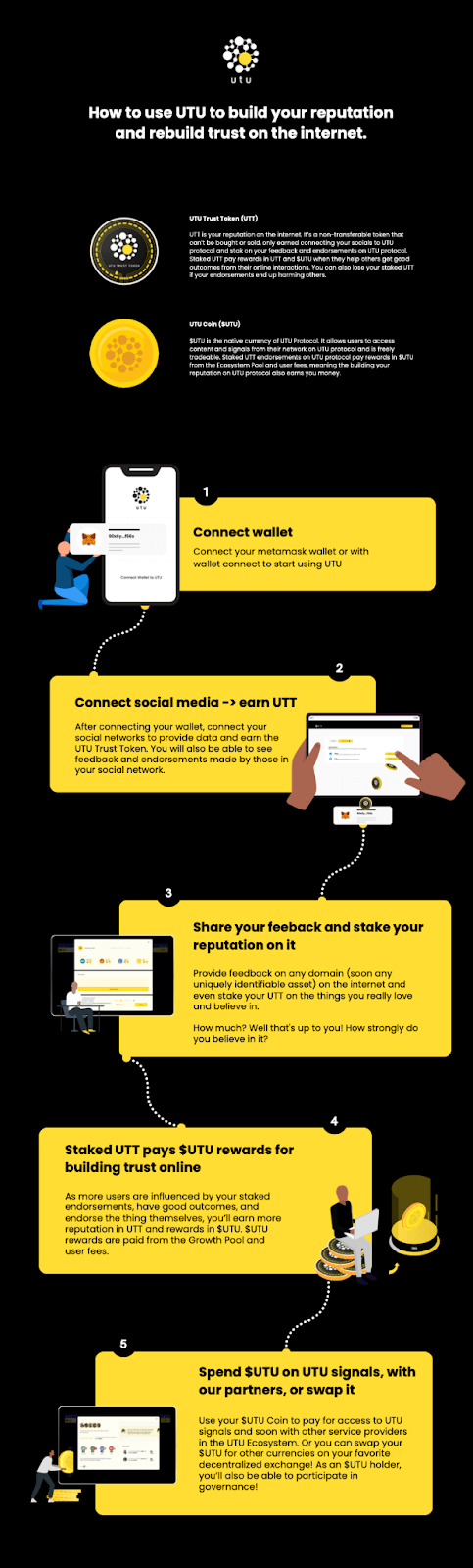
Currently, the main UTT smart contract is deployed on the Polygon network, while $UTU is deployed on Ethereum. Other EVM chains like Optimism and NEAR are supported via a proxy UTT contract, connected to the main UTT via Oracle (Chainlink), and bridged $UTU. We could not be more excited to add ICP to this list. For more details, please refer to our White Paper.
A Look Under the Hood – Bringing UTU to ICP
In this project, we will lay the foundation to make UTU Protocol directly available on IC. This involves the development of an IC UTT Proxy that runs as an IC canister and facilitates direct interaction with the main UTU Trust Token (UTT) contract on the Polygon network. This will allow IC users to make endorsements using their IC wallets. Our focus will be on ensuring efficient and secure communication between the IC and the Polygon network by leveraging the chain interoperability features of the IC. We’ve split the work into three milestones:
Milestone 1: Architecture and Initial IC UTT Proxy Version. UTU will define the technical architecture, requirements, and implementation strategy of the IC UTT Proxy (most likely using AssemblyScript). Our team will start by developing an initial and incomplete version of the IC UTT Proxy, including only a bare-bones implementation of the proxy side of the integration with the UTT contract. Attaining this milestone will be a necessary precursor for defining all the architectural modules of the IC UTT Proxy, along with its communication and data flow representation.
This milestone will serve as the reference for developing the best architecture for the product as various parameters, such as the best design approach, risk assessment, product robustness, design modularity, functionality, and endorsement simulation will be put into consideration.
Milestone 2: C UTT Proxy – UTT Initial Integration. UTU will deploy the proxy on an IC testnet. If necessary for the integration, we will develop a new UTT version and deploy it on sepolia testnet. Additionally, we will run successful integration tests and regression testing for a simulation of making endorsements on the IC UTT Proxy. These integration tests are successful when endorsements are correctly created (or not, in case of unfulfilled preconditions) in the relevant UTT version on Polygon Mumbai.
Basic unit test coverage and rudimentary integration testing will be crucial as defects will be identified, tracked, addressed, and retested until the IC UTT Proxy reaches the quality standards defined initially. Once this milestone has been attained, the IC UTT Proxy will be ready for more in-depth testing.
Milestone 3: Completion of IC UTT Proxy Functionality. UTU will complete the IC UTT Proxy implementation, including the implementation of the required functionality. We will complete unit tests for the proxy, and ensure that they have at least 90% coverage and that all are successful. Additionally, we will continue writing and performing integration tests for UTT integration, and fix any issues that arise. The IC UTT Proxy will be ready for deployment once this milestone has been achieved.
The project will be implemented over a three-month period. Each of the three milestones will be completed after each month. The proposed timeline strategically prioritizes the implementation of vital components of the integration development with UTT, including the initial testing phases during the early stages. The chosen approach will ensure that all potential and actual challenges are identified early to provide sufficient time to create and implement adjustments or solutions.

Oh the places we could go
After UTU deploys internet reputation on Internet Computer, we are excited to take on follow-on projects including all required dependencies such as bridging of UTU Coin, deploying oracles, etc. Following this, UTU is further committed to providing continuous support and improvement for the UTU Protocol integration on the IC. We will provide support by actively engaging with the IC community, collaborating with other developers, working with other teams with related projects, and promoting the adoption of UTU. We will also explore various follow-up projects, including:
- Deploying our Solidity UTT Proxy (including dependencies) on Bitfinity.
- Building IC-native user-facing apps to enable users to manage still more of their UTU usage directly on IC. This might include future features such as managing privacy and anonymity settings or UTU governance.
- Providing extensions of the IC UTT Proxy and UTT integration. This will include future extensions to UTU Protocol and the main UTT contract.
- If the integration of the IC UTT Proxy and UTT on Polygon work well, our team may also consider moving the main UTT contract to IC and integrating with other supported chains directly from there.
UTU’s Chief Trust Guardian Jason Eisen is also mentoring the current cohort of startups being incubated by ICP Kenya Hub, through the Olympus program, remarking:
“I’m excited for UTU to deploy internet reputation on Internet Computer and to see the energy in the Kenyan web 3 ecosystem brought about by ICP Hub Kenya and the unique bundling of user-centric features and services of ICP. The combination of strong tech, user obsession, and great community are a winning recipe. This is what excites me about bring UTU to ICP; I am pretty confident of the role they’ll play in the next internet and UTU very much wants to support that mission for our part of reputation, reviews, and trust.”
– Jason Eisen, Chief Trust Guardian, UTU
ICP Hub Kenya Co Founder Yvonne Kagondu said this of the collaboration with UTU:
“This partnership with UTU serves as a significant milestone for both UTU and ICP Hub Kenya as it guarantees the integration of a robust trust infrastructure directly into the Internet Computer ecosystem. By enabling seamless access to UTU’s review and reputation mechanisms, we aim to empower developers and users to build and interact with applications that prioritize trust and transparency, ultimately enhancing the overall user experience and security on the ICP network.”
-Yvonne Kagondu, Co-Founder, ICP Hub Kenya
About ICP Hub Kenya
ICP Hub Kenya is a pioneering force dedicated to advancing blockchain technology across the region and beyond. As one of the esteemed ICP Hubs worldwide, our mission is clear: to empower individuals and organizations through education, collaboration, and innovation in the realm of blockchain. With a steadfast commitment to fostering a vibrant ecosystem, we strive to catalyze growth, drive adoption, and unlock the transformative potential of blockchain technology for a brighter future. ICP Hub Kenya envisions a world where blockchain technology empowers individuals and organizations, enabling them to unlock their full potential. The Internet Computer is our chosen vessel for this vision, and we are dedicated to fueling its growth and adoption throughout East Africa.
Learn more about ICP Kenya Hub by visiting icphubkenya.io where you can learn about their education programs, startup incubator, and grant opportunities.
About ICP
The Internet Computer is a revolutionary blockchain that hosts unlimited data and computation on-chain letting developers build scalable Web3 dapps, DeFi, games, and more. The Internet Computer is a general-purpose blockchain that hosts canister smart contracts. It is designed to provide a World Computer that can replace traditional IT and host a new generation of Web 3.0 services and applications that run solely from the blockchain, without the need for traditional IT. It can also play the role of Web 3.0 orchestrator, by interacting with other blockchains. ICP’s vision is that most of the world’s software will be replaced by smart contracts. To achieve this vision, ICP is designed to make smart contracts as powerful as traditional software.
About UTU
UTU is building the trust infrastructure of the internet to help users and platforms interact in an easier, safer, and more trustworthy way. At our core, we are a decentralised reputation and reviews protocol with a non-tradable, stakeable reputation token (UTT) that yields rewards in both UTT and $UTU (our tradeable cryptocurrency) when users’ UTT-staked on-chain endorsements help others get good outcomes.
Starting with Web3 and DeFi apps, we provide AI-powered curation of trust signals from your network at just the right places and times to help users connect, send, swap, stake, and borrow with confidence.
A suite of trust tools have already been built atop UTU Protocol, including $UTU, UTU Trust Token (UTT), UTU’s Browser Extension (beta) for consumers, and Trust API/SDK for developers, as well as the Africa DeFi Alliance as a showcase of UTU’s Fintech APIs. We can’t wait to see what you’ll build atop UTU, to bring better trust to the internet.
UTU is proudly based in Nairobi, Kenya with trust guardians all over. Learn more about UTU on our website, Twitter, Telegram, Discord, LinkedIn, Reddit, YouTube, Facebook and Instagram.




No comment